Aliza Novacek-Olson
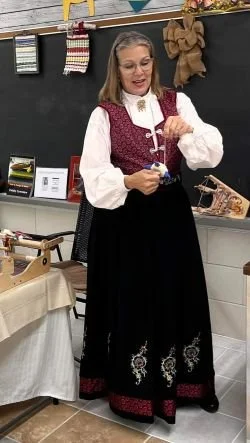
Fiber Artist Aliza Novacek-Olson
218-689-3131
HomespunLegacies@gmail.com
www.homespunlegacies.com
Facebook: Homespun Legacies
Instagram @homespun_legacies
Aliza is from Roseau and her business is Homespun Legacies. She offers a fiber art residency.
“Creativity belongs to everyone and it takes a different shape in every pair of hands.”
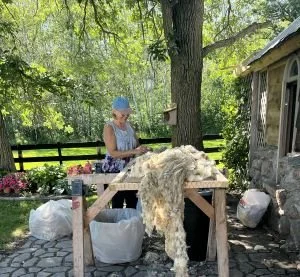
Aliza cleaning fleece
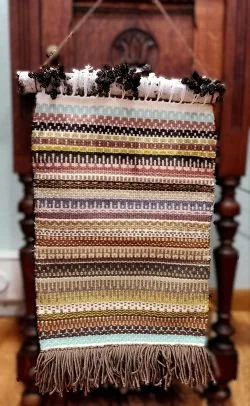
Natural dye weaving created by Aliza Novacek-Olson
Aliza Novacek-Olson is a fiber/textile artist based in Northwest Minnesota. Her work is rooted in traditional textile techniques and a deep respect for natural materials. Whenever possible, she begins with raw fiber—either from her own animals or locally sourced—and follows the same kinds of processes used by generations before her.
She works across a range of fiber arts, including weaving, needle felting, wet felting, spinning wool, natural dyeing, and nålbinding. Each piece reflects an interest in how textiles were made in the past and what those processes can teach us about daily life, culture, and resourcefulness.
A lifetime of living on a working farm shaped her understanding of materials and sustainability. That connection continues to guide her choices, from sourcing fibers to using plant-based dyes.
As a teaching artist, Aliza leads residencies focused on weaving and felting. She provides students with hands-on experiences while sharing the historical context behind the techniques they are learning. Her goal is for each participant to complete a piece of their own while gaining a deeper appreciation for the time, skill, and tradition behind handmade textiles.
Aliza has 25 years of teaching experience and she offers programs for schools, libraries, museums, festivals, and community groups. She’s available for demonstrations (traditional spinning and textile process demos), workshops (hands-on weaving, felting, and fiber arts), and school residencies (beginning weaving and needle felting).
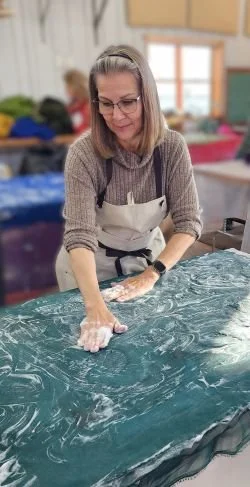
Aliza wet felting
FIBER ARTS RESIDENCY
Grade Level: Middle School grades 5-8
Length: 5 Days (50-minute sessions)
Class Size: up to 25
Location Needs: Classroom or art room (tables required)
Note: Please provide paraprofessionals to assist students with special needs.
Contact artist if modifications are needed for the project.
RESIDENCY OVERVIEW
Students investigate weaving as both a historical and contemporary art form. Across the five class periods, they learn essential weaving vocabulary, construct cardboard loom, warp the loom, and create a small woven wall hanging or mini placemat. Students practice plain weave, color changes, tucking in loose ends, texture techniques, short rows, finishing methods, rya knots, embellishment, and reflection through an artist statement.
The residency is intentionally structured so students will:
Explore fiber as line, texture, structure, and aesthetics through weaving.
Practice fine motor coordination and patience.
Make intentional choices about materials, color, texture, and process to communicate ideas.
Learn material science through hands-on experimentation.
Produce finished display-ready artwork.
The program culminates in one finished woven piece per student along with an artistic statement about their work.
LEARNING OBJECTIVES
Students will:
Artistic Skills
Understand fiber as an art medium.
Construct a loom and warp it.
Demonstrate plain weaving, correctly change colors.
Apply pattern through repetition and variation.
Practice craftsmanship and finishing techniques.
Cognitive & Academic Connections
Understand that weaving is both a functional and expressive art form found across cultures and time periods.
Practice sequencing and procedural thinking.
Cause-and-effect (material behavior).
Describing design choices verbally and in writing.
Reflection and critique.
Social-Emotional Learning
Persistence through slow processes.
Respect for tools and shared materials.
Pride in completed work.
Individual expression within structure.
DAILY RESIDENCY STRUCTURE
Day 1 — History of Weaving, Vocabulary, Loom Construction, and Warping.
Daily Objective: Students will be introduced to the basic history of weaving and to fiber art through tactile exploration and visual examples. They learn how to create a loom out of carboard and how to warp a loom.
Outcome: Every student will understand basic weaving vocabulary and leave with a loom that is cut, fully warped and ready to weave.
Day 2 — Plain Weave, Color Changes, and Tucking Ends.
Daily Objective: Students will demonstrate the over-under plain weave pattern, change colors, and tuck in loose thread ends as they work. They will model how artists make visual decisions using repetition, spacing, and material variation.
Outcome: Students will weave approximately one third of the project and demonstrate correct plain weave pattern, successful color changing, and a visible effort to tuck in ends.
Day 3 — Texture and Short Rows
Daily Objective: Students will use texture and/or short rows to add variation, dimension, and shape to their woven composition.
Outcome: Students will show evidence of experimentation, craftsmanship, and the ability to explain process choices.
Day 4 — Finish Weaving and Plan Embellishments
Daily Objective: Students will complete the woven section of the wall hanging and create a plan for finishing details and embellishments.
Outcome: Students will have the woven section complete or nearly complete and that each student has a realistic finishing plan.
Day 5 — Rya Knots, Embellishments, and Finishing
Daily Objective: Students will complete the wall hanging by adding rya knots and embellishments, removing the weaving from the loom, mounting it on a stick, tie a hanging thread and writing an artist statement.
Outcome: Students will show a completed woven piece, have a secure presentation, and written artist statement to be shown with their completed project.
Extension Options (for students finishing early):
Create a title card for the display.
Color a pattern weave on paper.
GOAL: At the end of the residency, students will show their completed project and artist statementin a school display cabinet or exhibited in a place where the public will be able to view such as a hallway exhibition, library display, or a community night event. The projects could also be entered into a country fair exhibition.
Classroom Environment
If possible, please provide a teacher or volunteer who will remain present to assist with classroom management and student support.
Other helpful supports:
Seating chart
Name labels on tables
* No prior fiber arts knowledge required.
Space Requirements
Tables or desks
Standard classroom seating
Storage area to place materials and projects between sessions
A place to hang and display printed visuals for students
Note: Actual projects may vary depending on age group and number of students.
Materials Needed
All specialty materials and tools are provided by the artist and are pre-proportioned into individual kits prior to the residency.
Pre-cut cardboard
Warp Yarn
Assorted acrylic yarn – worsted
Assorted bulky yarns
Textured and novelty yarns
Roving
Fabric strips and other miscellaneous materials
Long plastic needles
¼ inch dowels or chopsticks for sheds
Plastic forks
Colored masking tape
Natural materials such as pinecones, wheat, dried flowers, etc.
Embellishments such as decorative buttons, charms, small pins, beads, etc.
Sewing needle and thread
Labels
Plastic gallon size bags
Clips
Mounting or hanging supplies
Materials Provided by the School
Scissors
Pencils
Card Stock or color paper
2 Hot glue guns
Glue sticks
Copies of handouts
Please contact the artist for questions or to request changes to this proposed schedule.
Aliza Novacek-Olson at 218-689-3131, HomespunLegacies@gmail.com, 25501 County Road 13, Roseau, MN 56751
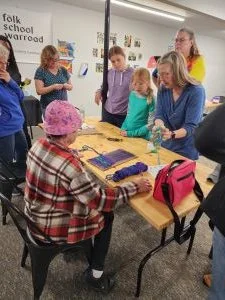
Aliza teaching